
Miracle in Red
An essay for early spring

Imagine the intensity of your revelation
The night the entire body of a star turns red
And you watch it as it rushes in flames
Across the black, down into the hills.

~from "Suppose Your Father Was a Redbird" by Pattiann Rogers
OUTSIDE
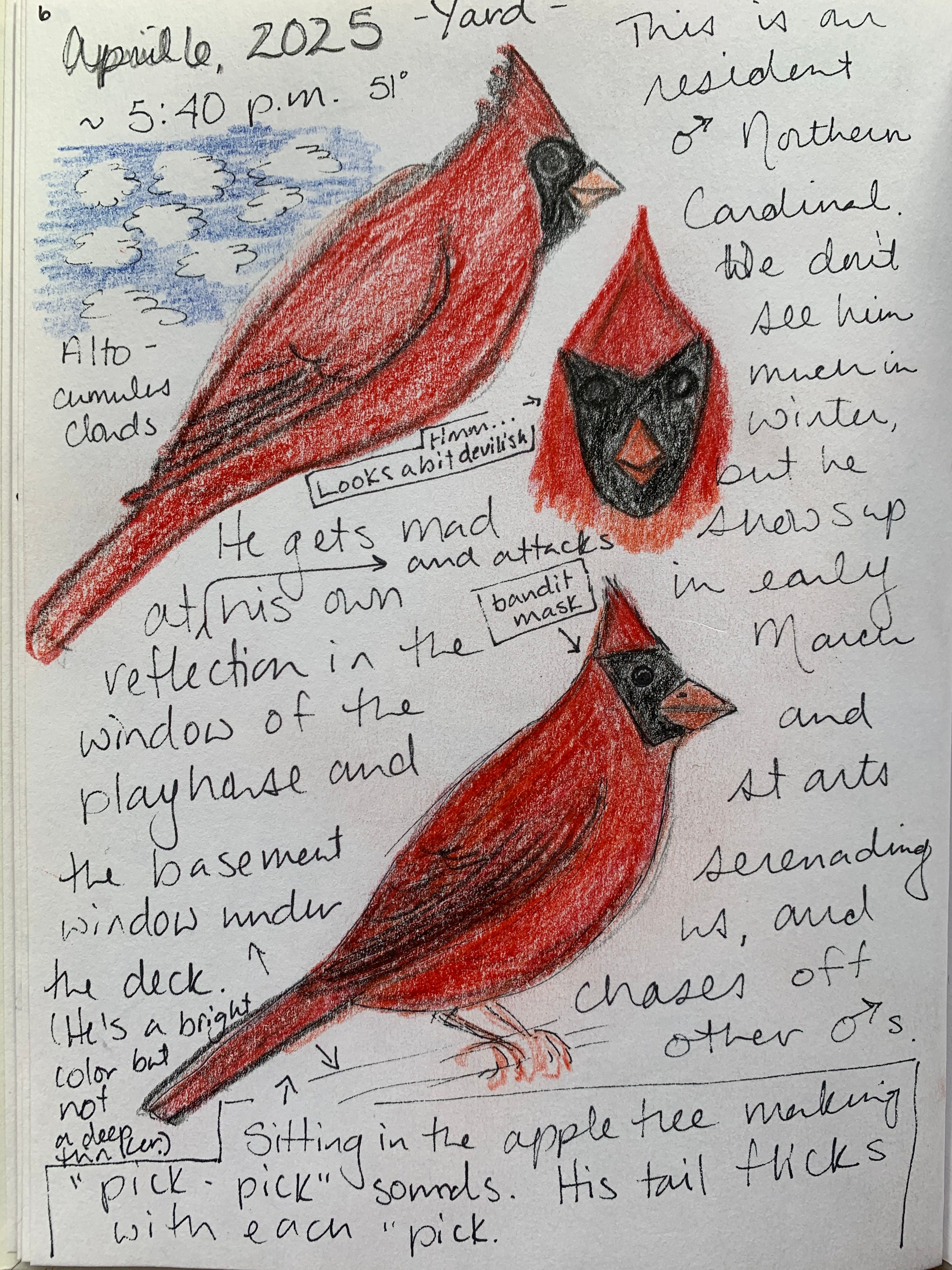
I wake to the sound of a northern cardinal singing: Cheer. Cheer. Cheer. What-what-what? Cheer! I’ve seen a pair hanging out near our feeding station off and on all winter, but today is the first time I’ve heard one singing this year. The cardinal’s song reminds me of a 1980s arcade game—spates of sharp, high-pitched cheers and chips, whats and wits, like spaceships blasting each other, but in a jolly, friendly sort of way.
The cardinal, with its wintertime visits to our feeder and its propensity for appearing on Christmas cards, is not a bird I normally associate with spring. But its shift into singing today is surely a sign of that most anticipated season being right around the corner, despite the eight inches of snow that fell over the weekend. Although the tufted titmice and black-capped chickadees have been optimistically warbling their spring songs since deep in February, the cardinal’s song feels more promising.
From the window that looks out over the birdfeeder, I can see the male cardinal, perched in the bare branches of an apple tree. Puffed up against the cold, he looks like a tomato with a tail and peaked cap. He’s an improbable shade of scarlet, the color of fire trucks and sports cars and the crayon labeled merely “red.” The only parts of him that aren’t brilliant, shocking red are his charcoal-dusted wings and the black mask that surrounds his bright black eyes.
The winged tomato flits from his perch in the apple tree to the tangle of kiwi vine that threatens to swallow our deck, where the female sits. She is like a negative image of the male—buffy-gold all over with only the faintest mist of red along the edges of her wing, tail, and crest feathers, as if she’d stood downwind of the male as he was being spray-painted. Her only concession to showiness is her bill, a big, triangular wedge of coral.
It’s a common misconception that only male birds sing, but in a number of species, including cardinals, females lend their voices to the chorus. The female cardinal will join the male in duets, as they volley a series of notes back and forth to each other. Though while the male belts out from a prominent perch, the female generally sings her quieter song from within the brush. She’ll also sing from the nest later in the season, directing her mate to bring her food as she incubates eggs and broods chicks. I stand by the window admiring the colorful pair for as long as they stay within sight, never growing tired of that lollipop red against the background of snowy ground and gray branches.
The cardinal’s vivid feathers aren’t completely unique; other birds in our area of Maine sport similarly bright plumes. Male hairy and downy woodpeckers have red napes; pileated woodpeckers have red crests; yellow-bellied sapsuckers have red foreheads and (in the males) chins; and red-bellied woodpeckers, despite their name, have heads that appear dipped in red paint. The male rose-breasted grosbeak has a tidy, triangular bib of crimson, and the male ruby-throated hummingbird is adorned with a red-sequined kerchief that shows off its brilliance when the sun hits it just right. Only the male scarlet tanager, whom I might glimpse a few times high in the trees in May, has all-over red feathers to rival the cardinal’s. Yet the cardinal’s propensity for hanging out near backyard bird feeders and in tangles of invasive weeds, combined, no doubt, with his Christmas-card fame, renders the bird a little bit ho-hum among serious birders. The cardinal is not rare, unusual, or irruptive. It’s never a surprise to see one at any time of year here in the northeast, but for me it’s always a delight. Every time I see a cardinal, I remember the first time I saw a cardinal, which was like Christmas and spring rolled into one.
The year-round range of the northern cardinal extends from Northern New England and the Great Lakes states south to Florida and Texas, from the shore of the Atlantic Ocean west to Kansas and Nebraska. I grew up outside of their zone, and the birds that flitted through my childhood backyard included robins, flickers, and magpies—each with its own charms, but none adorned in resplendent red regalia. Even after a year and a half spent in Texas and more than a year in Maine, I still hadn’t seen the redbird by the time I turned 21.
Birders call the species that got them into bird watching their “spark bird.” By the time of my first cardinal sighting, I’d gone into the forest with a friend to spy on black-capped chickadees—a bird this friend loved so much his license plate read PARUS, for the genus chickadees belonged to at the time, before being reclassified into the genus Poecile in 1998. In biology class, I’d stood on the beach in January, watching ducks rafting on the waves through a scope as my eyes streamed wind-induced tears that froze to my lashes and cheeks. I’d spent a summer in Idaho assisting a graduate student in her field studies of Osprey, and making collateral sightings of dozens of other birds species in between counting bites of fish the adult Osprey fed their young. You might say my interest in birding had already been sparked. But the moment I saw my first cardinal, I felt an actual spark, like a jolt of electricity.
It was spring break of my senior year in college, and I’d accompanied my friend Jennifer on a multi-state road trip to visit her far-flung family members. I’d never taken a spring break vacation before, and I’d always envied classmates who traveled to Hawaii or Cozumel or Belize in March and returned tanned, worldly, and adorned in seashell jewelry. I anticipated the road trip as my version of a Tropical Spring Break. In reality it was a comedy of errors, involving wrong turns, missed exits, and a broken-down borrowed car. I, who had far too little driving experience to be entrusted with East Coast interstates, found myself white-knuckling through six lanes of traffic and throwing handfuls of change at the coin-operated toll booths I stopped too far from. We traveled as far south as Savannah, Georgia, which, while not exactly Honolulu, had actual palm trees. And despite minor calamities, we had a grand time, shocking locals by swimming in the warm (relative to the still-ice-floe-dotted Gulf of Maine) ocean, wandering among the blooming azaleas in Forsyth Park, and driving north through a burgeoning spring in the Smoky Mountains.
For our last stop, we visited Jennifer’s mother in Western Pennsylvania. There, the three of us rode bikes along a rail trail that followed the course of a stream. Only the faintest haze of green and gold misted the canopy of deciduous trees we rode among, buds swelling in anticipation of the spring burst. A short way into our ride, I spied a wedge of crimson dart across this gray-brown tunnel, as if someone had folded an airplane out of bright red construction paper and tossed it from the trees on one side of the stream to those on the other. I could not believe my eyes, that a creature of such a clear, brilliant shade of red could exist in nature.
“Was that a cardinal?” I shouted to my companions.
“Yeah,” they replied. Ho-hum. After a lifetime in Pennsylvania, the bird was old hat to them. But to me it was like seeing a unicorn—a myth made real. I sat up straighter on my bike and opened my eyes wide, prepared for the next miracle that might cross my path.
Every time I see a cardinal, I remember that flash of luminous red in the leafless Pennsylvania woods. I remember the jolt of electricity that shot through me when I saw it. I remember spinning down the trail on a borrowed bike, young, carefree, and on spring break. I remember that the world is poised to amaze me, as long as I stay open to wonder.
INSIDE
Two years ago I started writing weekly short nature essays centered on one small event that I witnessed in the natural world and focused on joy. The motivation for this project was a rejection of the doomerism that pervades so much discourse around nature (let’s not even get into democracy). I know too many people who are constitutionally incapable of enjoying a warm, sunny day because of what it might mean about the climate. My goal wasn’t to deny or downplay or ignore the very real threats of climate change and all the rest, but to delight in the small, local, and everyday. I started strong and got 13 essays to a more or less finished state that spring. But with summer I got derailed and never got back on track.
When I started writing these essays, I considered doling them out in a newsletter like this one, but I wanted the imprimatur of publication. So I polished up some of the completed pieces and sent them out on submission. One got published. Another was rejected in short order, and another three were rejected after eighteen months in the slush pile. I’ve decided to publish a handful of them—one per month—on this platform. This should motivate me to write at least one every four weeks after I run out of spring essays. You’ll be the first to know if I falter. If I’d started doing so two years ago, I’d have half a book by now.
To accommodate these longer essays, I’ve changed the format here a bit: I’ve dropped the intro paragraph and moved the “Inside” (i.e., creative advice) portion of the newsletters to after the “Outside” bit (the essays), and I plan to keep it short. My advice this month (stolen from Austen Kleon, who I’m sure wouldn’t mind since he wrote Steal Like an Artist), as well as my plan for these essays, is: Show Your Work.
WRITING NEWS
I’m very excited to offer a writing workshop in April. I’d love it if you could join me. Pay Attention. Be Astonished. Tell About It: A Nature Writing Workshop
Charlotte Hobbs Library, Lovell, Maine, Saturday, April 11, 2026, 1-4 p.m.
Check out what I read last month in my February Reads post.
In last month’s newsletter, I forgot to include the link to my January Reads post, which includes my Puerto Rico reading list.
Yep, still winter in Maine, and so it’s not too late to check out “Hit the Beach this Winter” in the Green & Healthy Maine Winter Guide.
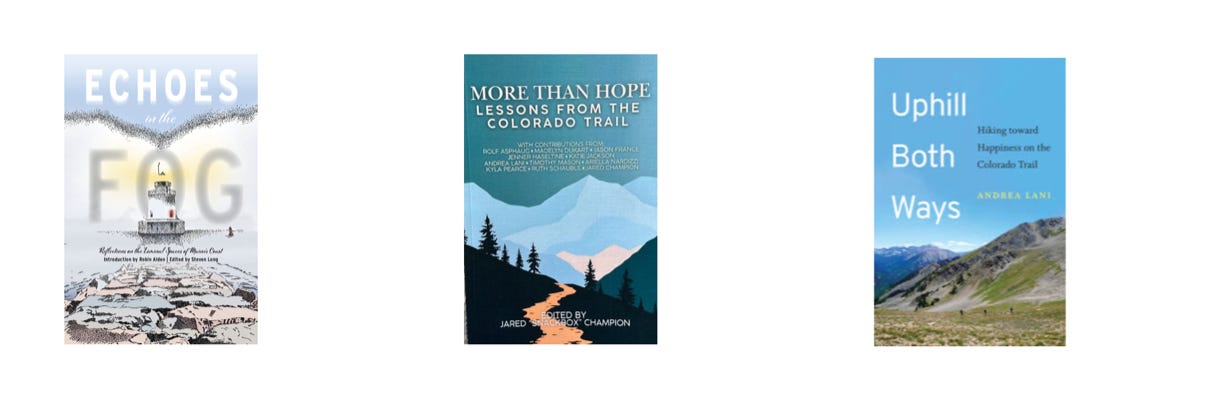
For a cozy read by the fire, pick up a copy of Echoes in the Fog: Literary Reflections on the Liminal Spaces of Maine’s Coast, and read my essay “The Saltwater Cure.”
If you’re starting to daydream about summer hikes, pick up a copy of my book, Uphill Both Ways: Hiking toward Happiness on the Colorado Trail.
For more writing, plus workshops and editing services, visit www.AndreaLani.com.
"....as if she’d stood downwind of the male as he was being spray-painted." Such a great line!