
Feathered Acrobats
An Essay for Late Spring

They are dark
angels glimpsed
from the corner of
they eye, a flash
of wings
in twilight

~from "Swallows" by Robert Kinsley
OUTSIDE
Around dinner time each day, we are treated to an aeronautical display, our own personal phalanx of Blue Angels, as anywhere from one to eight sickle-winged, notch-tailed aircraft soar, dip, dive, and weave through the airspace above our yard.
The stars of this daily airshow are tree swallows, small, agile birds with diminutive legs and bills. From above, the males are adorned, from their beaks to their tails, in feathers colored the iridescent blue-green of abalone shell. Below they’re snowy white from their chin to their feet. The females have the same color pattern, but their upper feathers are a more neutral brown, with traces of blue. The swallow’s flight appears both elegant and effortless—they can glide long distances, flap their wings rapidly to put on speed, and dart through the tiny opening in the front of a nest box.
Swallows harvest insects in flight, and it may be that when they take to the air this time of day they’re gleaning their evening meal, relieving us of some of our early mosquito population. They may also be showing off to potential mates or rivals or keeping their muscles in shape for the migration to the southern US or Mexico that they’ll undertake in a few months. But to me, earthbound and lacking their speed and agility, they look like they’re winging through the air for the fun of it.
When the swallows begin their evening airshow, it’s time to get out the feather cannon. A 10-foot length of narrow plastic pipe, the feather cannon is Curry’s invention, and he’s its primary operator. First he takes a white feather that he’s collected from the yard or the duck coop and preens it by sliding it between his fingertips to rub off dirt and smooth out the barbs. Then he pokes the tidied feather into one end of the cannon and, holding it up nearly vertical, blows through the other end, launching the feather into the air. If he’s timed it right, a breeze will catch and carry the feather and a swallow will snag it out of the air with an audible snap of its bill.
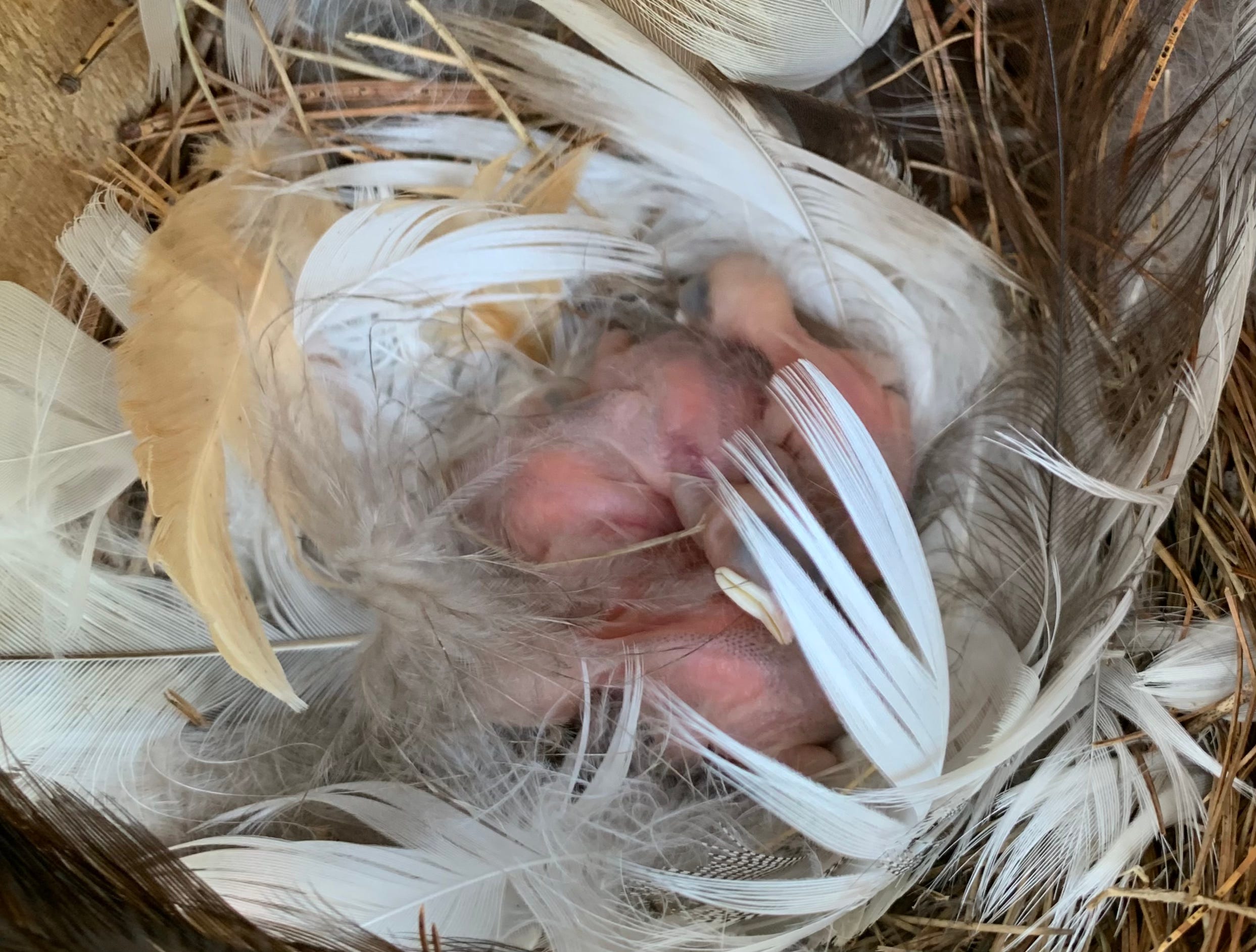
We have twelve nest boxes distributed around our property, and this year at least two of them have been claimed by swallows, one in our yard and another in the back field. Each of these boxes holds six small ivory-colored eggs within a bower of white feathers arranged quill-end down. The naturalist Bernd Heinrich wrote a whole book about the phenomenon of tree swallows lining their nests with white feathers (called, naturally, White Feathers), in which he documents a number of experiments he conducted to determine whether swallows actually prefer white feathers over dark ones. He concluded that yes, they do like the white ones best, although they will make use of darker ones. As to why they favor white feathers, Heinrich proposes a few hypotheses, the simplest and most logical being that the preference grew out of the fact that white feathers are easier to see against the dark background of the earth. Another is that the white eggs are harder for predators to see within their white next.
My personal theory is that swallows use the white feathers to disguise their untidy housekeeping, like humans stuffing dirty laundry and clutter into a closet before guests arrive. When I’ve emptied out the nest boxes of wrens, bluebirds, titmice, and chickadees in the fall, these birds have left behind relatively clean piles of grass or twigs or moss. In the tree swallows’ abandoned nest boxes, by contrast, I find filthy mounds of wet hay matted with dirt and poop and infested with ants. In the swallows’ defense, the parent birds practice nest hygiene with younger nestlings, according to Heinrich, and this slovenly condition only comes to pass near the end of the nesting period, when the almost-fledglings demand constant feedings and the adults can’t get past the young blocking the nest box entrance to remove their fecal packets. I have witnessed comparable disarray in human teenagers’ bedrooms and can relate to parents losing the will to clean up after their nearly grown offspring.
Over the years of his swallow studies, Heinrich observed adult swallows collecting feathers at different times during the nesting period, usually not until after the first egg had been laid. The parents continued to gather feathers even once the nestlings hatched. Heinrich generally laid feathers out on the ground near the birds’ nest box, but sometimes held them up for the birds to take from his hand. Before long the swallows began to associate Heinrich with feathers and would approach him even when he didn’t have a feather in hand, as if to coax him into providing one.
We’ve witnessed a similar phenomenon with the feather cannon. Once the swallows have seen it in action, they learn to anticipate it. The swallows that nest in the box in our yard like to perch on a horizontal, dead branch of a double-trunked cherry directly across the lawn from our house. Before they began brooding eggs, both the male and female would sit together on the branch, burbling their liquid song. Now only the male sits there while the female hangs out inside the nest box with the eggs, her tiny, snub-nosed face peeking out the opening.
From the cherry tree perch, the swallow has an unimpeded view of the house and the deck, and when he sees one of us raise that slender white pipe, he gets ready, flying across the yard and hovering near the business end of the cannon. When the feather launches, he, along with any other neighborhood swallows who are patrolling the sky nearby, is there, ready to snatch it before it’s sailed more than a few feet. If our yard swallow grabs the feather, he swoops across the lawn and disappears behind the apple tree that obscures our view of his nest box, tucking it inside with the growing collection. If one of the other swallows does, it disappears over the trees, taking its prize home.
This evening, I step out on the deck after dinner, into a chorus of gray tree frogs trilling their calls from every direction. A tree swallow peers into an empty nest box in the yard, then flits inside and pokes its head out. I decide to see if I can attract it with the feather cannon. I don’t have Curry’s knack for gauging oncoming gusts of wind, nor do I have the lung capacity needed to give the feathers extra lift. Often my feathers drift languidly down to earth and end up lost in the overgrown lawn.
The container we store feather ammunition in is empty, and a thunderstorm rolled through earlier, soaking everything with rain. I assume any feathers lying around will be waterlogged, so I go inside the house and liberate one that’s sticking quill-end-out from a couch pillow. I stuff it into the cannon and puff. The feather drifts on a current of air, but the swallow in the nest box stays put. Out of nowhere a different swallow swoops in and snatches the feather. Three more appear in the sky above, chittering and swooping. They’re here to dart and dive for feathers, and I’ve just teased them with my paltry offering and depleted reserves. The swallows perform their acrobatics for a few minutes, wheeling through the air, weightless and free, before they realize no feathers are on offer and disperse back to their evening rounds of insect-catching, leaving me behind, clay-footed, holding the cannon and empty box of feathers.
INSIDE
As I sit here on the deck typing this, one of my kids is mending the sleeve of a sweater he bought for a bargain. He learned the whip stitch from hand-sewing the binding onto a quilt he made before he left for Costa Rica for the semester and finished in the days after he returned. Another kid is spray-painting letters he painstakingly cut out of foam core onto the back of a t-shirt. The shirt is part of a clothing line he’s been creating over the past few months, which so far includes three pairs of sweatpants he made from a pattern he cut out of pizza boxes, innumerable modified and redecorated t-shirts and sweatshirts, and a half-finished hoodie.
I take a little credit for this craftiness—all those years of holiday gift-making sweatshops around the kitchen table, of letting three- and four-year-olds loose with scissors, needle and thread, skeins of yarn, fabric paint. I’m also the one who comes to the rescue when the bobbin thread jams, which is often. But, their boldness, their willingness to try things out, without worrying about results, failures, or wasted materials, these are traits I wish I possessed to the degree they do.
When I teach nature journaling, I try to get this across to my students: creativity shouldn’t be scary or stressful. Making something from nothing—whether a sketch or a quilt or a t-shirt or a poem—is pleasurable and satisfying even if you’re not “good” at it, even if your result is not in line with your vision. Still I struggle with this myself: fear of wasting time or supplies; anxiety about getting started before I become an expert on whatever it is I want to create, whether it’s a novel or a watercolor.
Essayists often write that the word “essay,” as a noun, means an attempt or a trial, and, as a verb, means to try, with the implication that through the process of writing an essay you figure out what you want to say, even what you think. When I struggle with an essay, I try (see what I did there?) to remind myself of this: I don’t have to have it all figured out; I just need to try. I’m now thinking that this idea could apply to any creative endeavor. What if I took the pressure out of “write a book” or “paint a picture” and instead told myself that I was going to try to do these things, that I don’t need to read 50 books on how to write or watch 50 tutorials on how to paint before I just try (although some instruction is good)? I just need to try, and in the trying, I will find my way to the doing.
What creative activity have you been avoiding, because you don’t feel prepared or expert enough to do it yet? What if you just tried?
WRITING NEWS
I’m in the process of setting up some writing and nature journaling workshops for this summer and fall. Nothing is finalized yet, but keep an eye on the Workshops page of my website for upcoming dates.
Speaking of my website, I recently gave it a little spring cleaning, trimming down the number of pages, updating information, and replacing the headers with some artwork you might recognize from this newsletter. Give it a look-see!
Check out an even more eclectic stack of books than usual in my April Reads post.
If you’re in Maine, keep an eye out at your local coffee shop, natural foods store, or tourist information site for Green & Healthy Maine Summer Guide 2026, in which I have two articles, coming out in mid-June.
If a spring paddle is on your armchair travel list, take a look at my essay “Our River” in the 2026 issue of Spire: The Maine Journal of Conservation and Sustainability.
With beach season around the corner, it’s a good time to pick up a copy of Echoes in the Fog: Literary Reflections on the Liminal Spaces of Maine’s Coast, and read my essay “The Saltwater Cure.”
If you’re starting to daydream about summer hikes, pick up a copy of my book, Uphill Both Ways: Hiking toward Happiness on the Colorado Trail.

For more writing, plus workshops and editing services, visit www.AndreaLani.com.
A feather cannon....brilliant! Lovely post on these fantastic fliers!
That’s what I came here to say. A feather cannon! That’s amazing. Love this so much.