
Emerald Cities
A Mid-Summer Essay

For I praise them, not needing to search for dragonflies (the way birders search for birds) but let them fly to me

For sometimes their wings have stigma and in the wind I watch their wings and abdomen sway while their head and thorax are still

For this one's a male whose spider-web wings and abdomen are tipped sky blue

For might it be the same damselfly that alights on the arm of my chair as I write

~from "For I Will Consider the Overlooked Dragonfly" by Sharon Dolin
OUTSIDE
On the Fourth of July—and the fourth day of a heat wave—Curry and I hike through the woods to the river that runs along the western boundary of our property. It exerts a pull on us this time of year—the cool water, the shade of the hemlock forest, the way that the air here manages to somehow be drier than it is at the house. Even the deer flies and mosquitoes that hound us on the trail vanish. When we step into the river, we enter an enchanted place.
Water striders swirl over the surface like a phalanx of six-legged figure skaters warming up on the ice before a competition. They are slender, dark-bodied, leggy insects that are more easily seen by the shadows they cast on the riverbed: an arrangement of six ovals formed by the depression each foot makes in the water’s surface tension, plus one long, skinny oval cast by the body. The striders’ lower leg segmets—tibias and tarsi—are covered in water-repellent hairs that alow them to skate over the water without sinking or getting wet.
The water is shallow and clear, though with each step we stir up little clouds of silt—the legacy of the town replacing an upstream culvert without adequate erosion controls—and the stream bed is littered in blocky rocks furred with brown algae. Little fishes rove among the rocks and over patches of coppery sand. Ranging in size from paperclip to pocketknife, they hover in place, dart across riffles and around little pools, or just swirl around in loose bands that I hesitate to call schools because they don’t appear that cohesive.
The fish scoot out of our path as we make our way upstream. I’ve learned from painful experience to wear old sneakers to walk in the river and to use a decommisioned ski pole for balance, support, and gauging the depth of the water. Curry, too, carries a pole, and he brings it up to show me a leech clasped onto the metal tip. It’s about an inch long scrunched up, but when it stretches out, searching for something to grab onto, it grows to two or three times that length, while becoming commensurately skinnier. Its upper side is a pretty shade of dark olive green with a row of tiny, coral dots running along the midline that match its salmon-pink underside. Curry tries to shake it loose, but it won’t let go, and I pluck it free of the pole and toss it back into its river home.
Tiny damselflies—turquoise bluets and lavender dancers—hover low over the water, lifting off and alighting on vegetation and rocks, chasing away rivals, flying in tandem with mates. Damselflies are generally much smaller than dragonflies, fragile-looking by comparison, with slender abdomens, narrow wings, and a weaker flight. Their bulbous eyes are located at either side of their heads, and, except for the spread-wing damsels, they rest with their wings folded over their back.
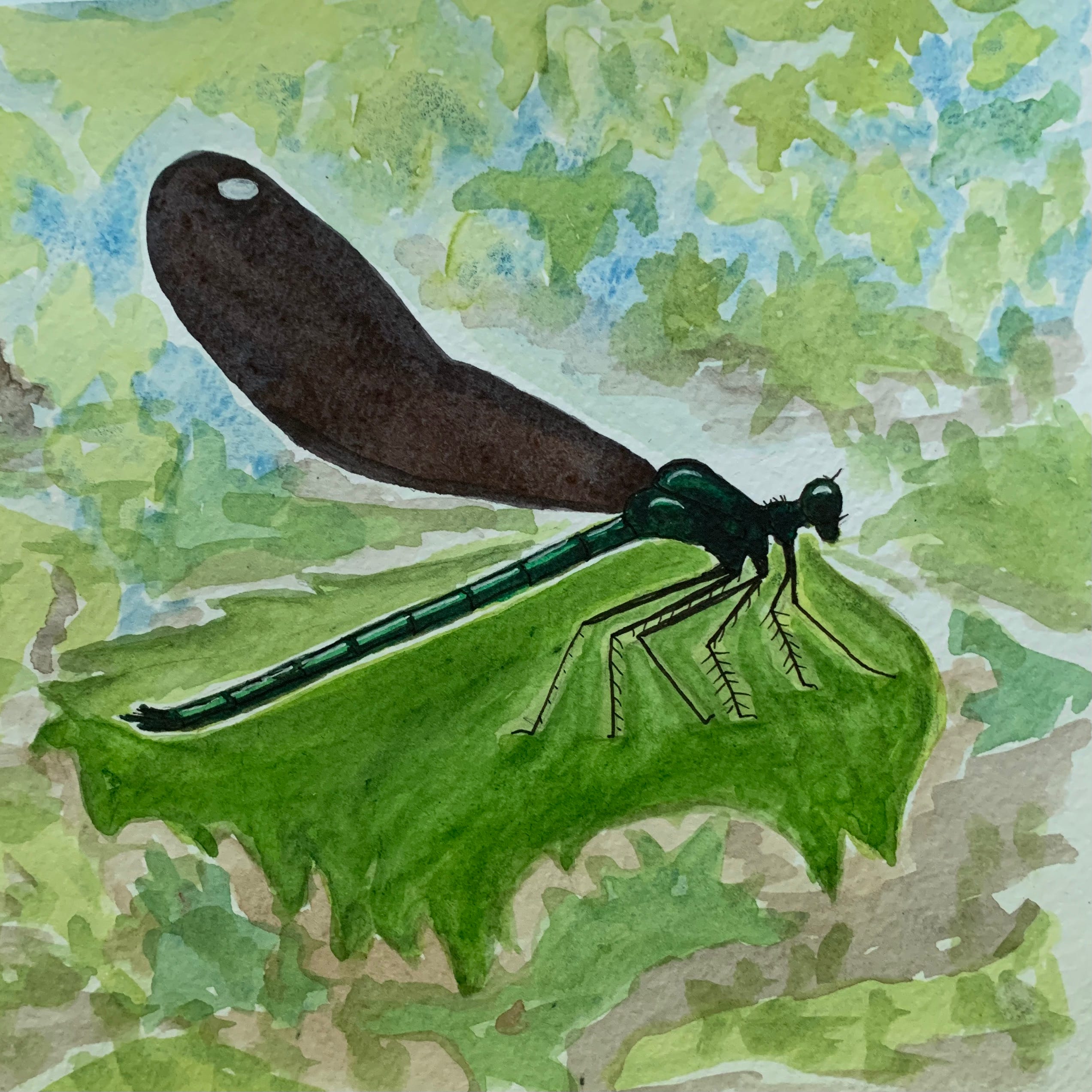
Larger damselflies, called ebony jewelwings, flicker among the leaves and needles of low-hanging branches like Christmas lights. The head, thorax, and abdomen of these glittering gem-like insects shine a bright, iridescent green, and their wings are deep, velvety black. The metallic color of the body comes not from pigment but is created by microscopic structures in the damselfly’s exoskeleton that reflect and refract light. In direct sunlight, the damsel’s body shows up its emerald best, in shadow it’s almost black, and when the light comes from directly behind, the jewelwing appears a brilliant manganese blue, in the same way a mallard’s green head looks purple when backlit. The male is brighter in color than the female, with a thin line of metallic green on the leading edge of its wings, and the female has a stark white spot, called a stigma, on the upper edge of her wings.
A patch of green beneath the water that’s almost as bright as the jewel wings draws my eye, and I pick up a diamond-shaped rock and study the tiny verdant world coating one sharp corner. It looks like a miniature Emerald City, made up of hollow towers and spires and skyscrapers crowded together, each only millimeters high. This verdant growth is a freshwater sponge, in the family Spongillidae, and it is in fact something akin to a city—a colony of tiny animals that aggregate together in a structured mass, similar to coral. Under a microscope the sponge looks like a cross between a moss and a cactus, and though it appears soft and slippery, it feels rough, like fine-grit sandpaper. Its structure is made of silica and its Kelly green color comes from algae that live simbiotically within the soft part of the sponge’s body. The sponge gets some of its sustenance from the food the aglae make through photosynthesis and the rest from nutrients it filters out of the water through the slender tubes or pores I can just barely.
The first time I saw these tiny green cities in our river was on one of those days that you can tell from the moment you wake up is going to be the most perfect of the year. I called in sick to work and kept the kids home from daycare, and we made our way to the river. As we waded upstream, I stalked damselflies with my cameral and the kids, who were about ten and six at the time, chased after minnows, which they called “chubbies” that day, and caught frogs, which they called “skinnies.” They mucked around in the riverbed, finding dragonfly nymphs and crayfish, and my oldest son picked up a rock that was completely coated in a bright green growth. Once he drew our attention to that one emerald-encrusted rock, we saw them everywhere beneath the water. It wasn’t moss or algae, but I couldn’t imagine what it was, and the next day at work, I hunted up a water quality specialist and learned that we’d found freshwater sponges and that they’re an indicator of clean water.
There are only about 300 known species of freshwater sponge worldwide, and fewer than 30 in the United States. In an 1883 article in the Bulletin of the United States Fish Commission called “Fresh-Water Sponges: What, Where, and Who Wants Them,” the author, Edward Potts, laments the lack of general interest in freshwater sponges, attributing this indifference to the fact that only two species had been found and described in England and Europe at that time. “The zeal, therefore, enlisted in the search for them,” he writes, “has been far less than the puzzling character of their organization—upon the border-land of animal and vegetable life—and the beauty and quaintness of form of some of their component parts would seem naturally to invite.”
I have to agree with Potts about the beauty and quaintness of the sponges, and I was distressed when, over the last several years, we no longer found any in our river. The sponges were, I assumed, another casualty of sediment washed downstream when the culvert was replaced. But as we wade back downstream I see more viridian patches here and there on the rocks. Each colony ranges in size from about a quarter to a playing card, none as large as the rock-covering carpets the boys and I found on that July day fifteen years ago, but each spot of green is a little spark of hope.
INSIDE
Earlier this month, I had the great good fortune to spend a few days at a cabin on a lake all by myself. Even though my kids are (mostly) grown now and I’m not working a full-time job, a retreat like this, free of (most) distractions (unfortunately, while there was no internet, there was still enough cell service to waste some time every day reading about diarrhea lettuce; next time I’ll lock my phone in my glove box and throw away the key), still feels essential. It’s amazing how long the days are when you don’t have to cook (I ate granola and yogurt, cheese and crackers, and prepared meals from the local co-op), clean, or watch TV. It’s amazing how restorative it is to sit in silence, with nothing but calling loons, whispering trees, and the occasional passing canoe.
I moved from lake to dock to screen porch. I walked the camp road in the mornings (bug zapper in hand). I swam. I read. I sketched. I knitted. I went to sleep early enough that I never had to turn on the lights, other than my tiny, battery-powered reading light. I reviewed my in-process writing projects, evaluated what work remained, and made some decisions about how to proceed. I wrote, a bit. I stayed an extra day. I came home refreshed and refocused and ready to create. I’ve been thinking about how to recreate the retreat experience in my everyday life.
What ways have you found to create a incorporate retreats into your creative practice?
UPCOMING WORKSHOPS
Pay Attention. Be Astonished. Tell About It: A Nature Writing Workshop
Multiple locations:
Falmouth Public Library, Saturday, August 29, 2026, 2-4 p.m., Falmouth, Maine
Turner Public Library, Saturday, September 19, 2026, 1-4 p.m., Turner, Maine
Orono Public Library, Saturday, October 3, 2026, 1-4 p.m., Orono, Maine
Bethel Public Library, Saturday, October 10, 2026, 2-4 p.m., Bethel, Maine
Check out the Workshops page on my website for more information.
WRITING NEWS
You can read my essay “Our River” in the 10th anniversary issue of the Spire: The Maine Journal of Conservation and Sustainability.
Check out my two articles, one on the big trees of Maine and the other on invasive plants, in the latest Green & Healthy Maine Summer magazine. Find a copy at your local coffee shop, natural foods store, or tourist information site.
For a list of books I read in June, see my June 2026 Reads post.
Now that hiking season is in full swing, why not pick up a copy of my book, Uphill Both Ways: Hiking toward Happiness on the Colorado Trail?

Fabulous piece 💚